
East of Cambridge
Forest City 1 is a proposal to build a new city of up to 1 million people on 45,000 acres east of Cambridge. Led by the Albion City Development Corporation, it launched publicly in October 2025 and immediately generated national attention, local opposition, and a politically charged conversation spanning housing, agriculture, water, nature and democratic accountability.

"famille were asked by the Forest City project to gather social media data and assess attitudinal responses to the plans for the UK's first city in over 50 years. Their final report will be incredibly important, not only in framing the project's responses to community outreach but also in informing stakeholders and decision-makers in the coming months. I can't praise their work and speed of delivery highly enough."
Shiv Malik, Co-founder, Albion City Development Corporation (Forest City 1)
famille was asked to gather social media data and assess attitudinal responses across the early months of the project’s public life.
famille was specifically brought in to deliver an objective assessment without bias or favour, which is an important values-driven aspect of any work famille does.
The team needed to work quickly. With public meetings being held, media coverage accelerating, and local and national political figures weighing in, the Forest City 1 team needed an honest, evidence-based picture of how the proposal was landing online before positions hardened further.
What we did
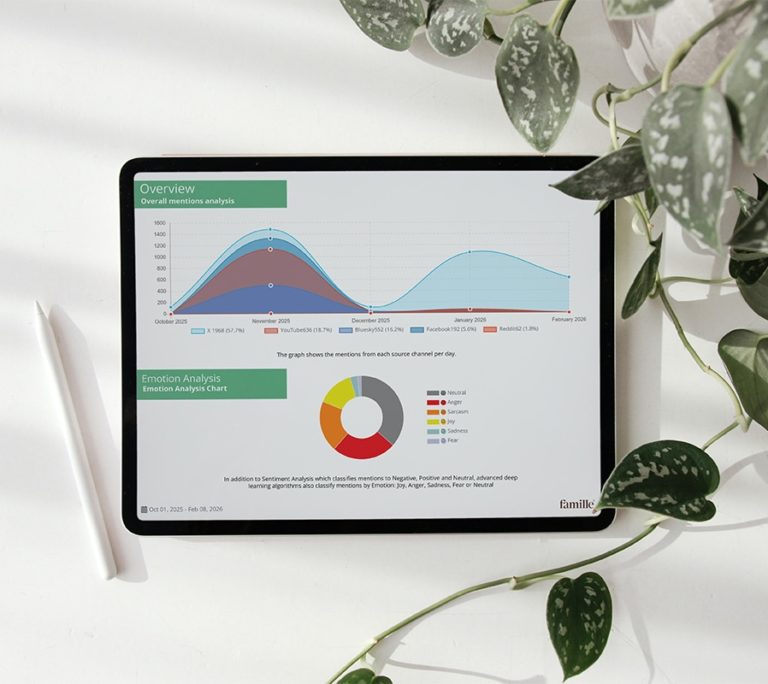
We analysed social media conversations about Forest City 1 between October 2025 and February 2026, across X, YouTube, Bluesky, Facebook, Reddit and LinkedIn. To ensure the report reflected genuine public response rather than project-generated content, we filtered out the founders’ accounts while retaining all replies and reactions to their posts.
We combined automated sentiment and emotion classification (using deep learning algorithms to identify anger, fear, joy, sadness and sarcasm alongside standard positive/negative/neutral scoring) with qualitative human analysis of the themes, concerns and questions surfacing in real conversations. The report was designed to be shared directly with stakeholders and decision-makers, not just the communications team.
The conversation was large but concentrated. X accounted for nearly 58% of all mentions, driven largely by responses to the founder’s personal account. Forest City 1 had no social media presence of its own at this stage.
Negative sentiment outweighed positive by roughly two to one, with anger (24.8%) and sarcasm (19.9%) the dominant emotions. But the single largest segment was neutral (36.7%), representing people still forming a view, asking questions, and exploring ideas. This was a critical finding: the persuadable middle was larger than either the advocates or the opponents.
Concerns about agricultural land loss, water scarcity, the fate of existing villages, and the use of development corporation powers appeared repeatedly. Positive voices focused on the ambition itself, the housing need, and the environmental vision, but were notably quieter in volume.

The report went beyond data. famille’s summary identified a specific dynamic: that the loudest oppositional voices risked silencing those who were curious or supportive but had not yet committed to a position. This had direct implications for how Forest City 1 should communicate in its next phase.
We recommended that future communications be underpinned by an anti-greenwash policy, reduce technical language that can create divides, respond consistently and without judgement to critical voices, move beyond reliance on X to reach a broader cross-section of the community, and help people imagine what living in the city could actually feel like. We also advised leaning further into nature and regenerative practices while honestly acknowledging public pride in existing farmland and anxiety about food security.
This was not a routine listening report. Forest City 1 is arguably the most ambitious placemaking proposal in the UK today, which also brings division. The conversation around it involves deeply held feelings about land, identity, democracy and generational fairness. Getting an accurate, unvarnished read on that conversation, fast, gave the project team evidence they could act on and share with the people who would shape what came next.
We listen to what communities are already saying, make sense of it, and help you deliver projects that build support and tackle challenges head-on.