
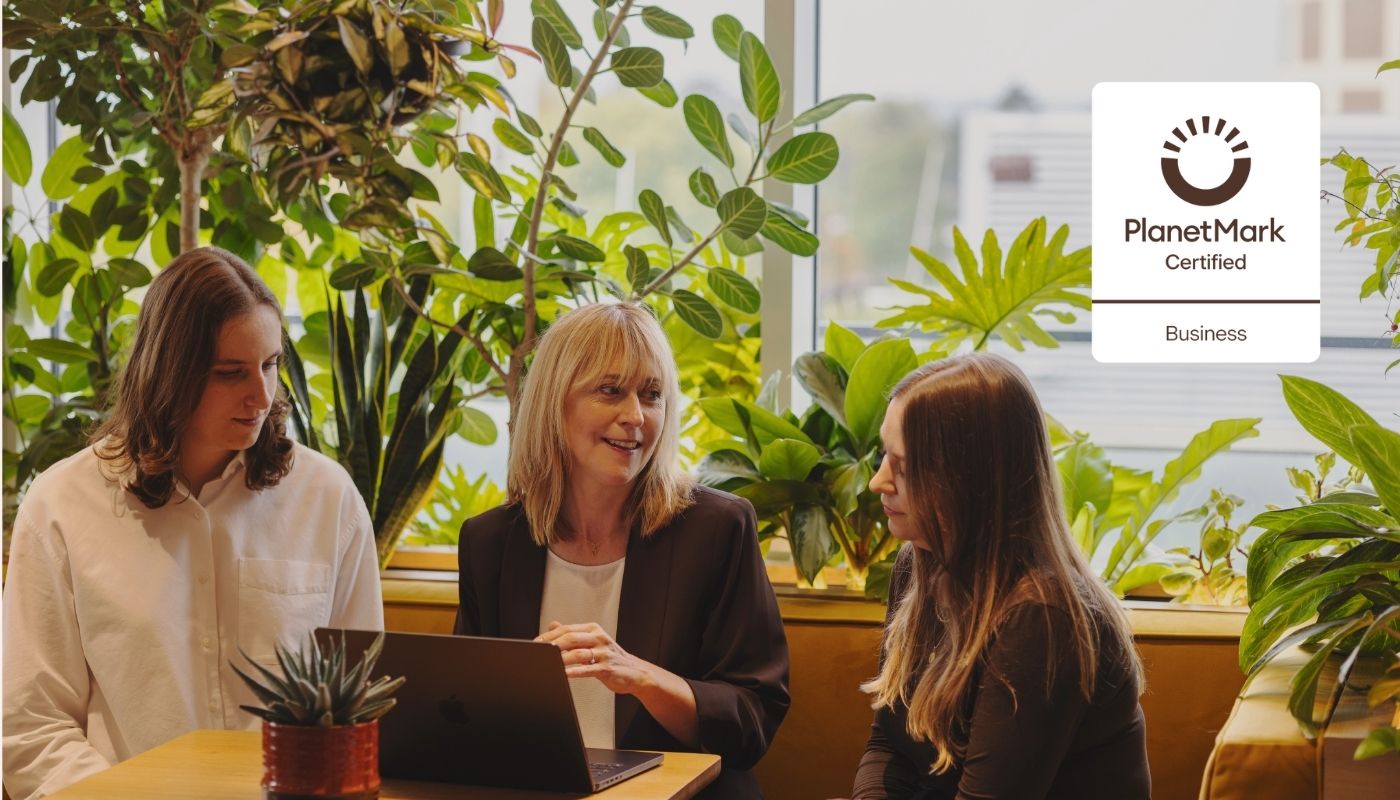
We are proud to announce that famille is now a Planet Mark Certified Business!
At famille, we don’t just advise our clients on sustainability- its a commitment we are actively pursuing ourselves. Our certification with Planet Mark is an important milestone on our journey to net zero and reflects our ongoing dedication to reducing our environmental impact at a critical moment for the planet.
What is Planet Mark?
Planet Mark is an internationally recognised leader in net zero certification, with over 12 years of experience in helping organisations reduce carbon emissions, achieve net zero targets and generate long-term business value.
Recognised by the United Nations Framework Convention on Climate Change (UNFCCC) and partnered with the UK UN High-Level Climate Champions, Planet Mark supports more than 800 organisations in taking climate action. They are also part of the sustainability-focused Alcumus Group.
famille’s journey so far
At famille, we strive to put sustainability at the forefront of our business operations. Our commitment to operating sustainably has been reflected in many previous business decisions.
We chose a Planet Mark certified business, Fora, as our office provider, meaning we can keep our location-based emissions down. We have opted to use ethical banks and green pension investments to ensure our financial operations are sustainable. We also try to source our goods from local businesses.
As part of our Planet Mark Certification, we undertook an environmental audit to better understand and measure our carbon footprint. This process involved defining our measurement boundary- identifying the emissions we need to monitor- and reporting our findings. Understanding our carbon footprint is the first step to reducing it.
In 2025, famille reported:
- 1.2 tCO₂e market-based carbon emissions
- 0.5 tCO₂e emissions per employee
- 1.2 tCO₂e location-based emissions
Our emissions breakdown was:
- 2.81% Scope 1 emissions (direct emissions produced by our operations)
- 40.64% Scope 2 emissions (indirect emissions from purchased energy)
- 56.55% Scope 3 emissions (emissions generated within our value chain)
These insights provide a clear foundation for future reductions and further sustainable decision-making across our business.
Our next steps…
Our journey isn’t over yet.
In order to recertify each year, Planet Mark requires businesses to expand their measurement remit and reduce Scope 1 and 2 emissions by at least 5% annually.
Over the coming year, we plan to continue to make environmentally responsible choices and take further steps to reduce our carbon emissions.
One of the targets Planet Mark set us was to improve our data quality. As a result, we are now recording our travel monthly to improve accuracy, and we are working with our office provider to obtain better evidence of emissions. We will also be looking at our goods and services suppliers with greater scrutiny.
We are looking forward to maintaining our certification and continuing our journey to net zero!
Glossary
Net Zero: The end goal, involving cutting greenhouse gas emissions to as close to zero as possible, and reabsorbing remaining emissions from the atmosphere via carbon removal offsetting schemes. The SBTi Corporate Net Zero Standard requires organisations to reduce emissions by at least 90%, as close to zero as possible. Only the remaining maximum 10% may be neutralised using carbon offsetting schemes.
Carbon emissions: The release of carbon-based gases into the atmosphere. As these gases accumulate, they act as greenhouse gases, trapping heat in the atmosphere and leading to climate change.
Carbon footprint: The total amount of greenhouse gases released into the atmosphere by human activities, in this case those of a business.